We advise organisations on structure, culture and collaboration. An assignment begins with clarifying the brief and is usually set up as an architecture of modules that can also be commissioned individually.
CDN supports organisations through change, culture work and team development — systemically, not by recipe.
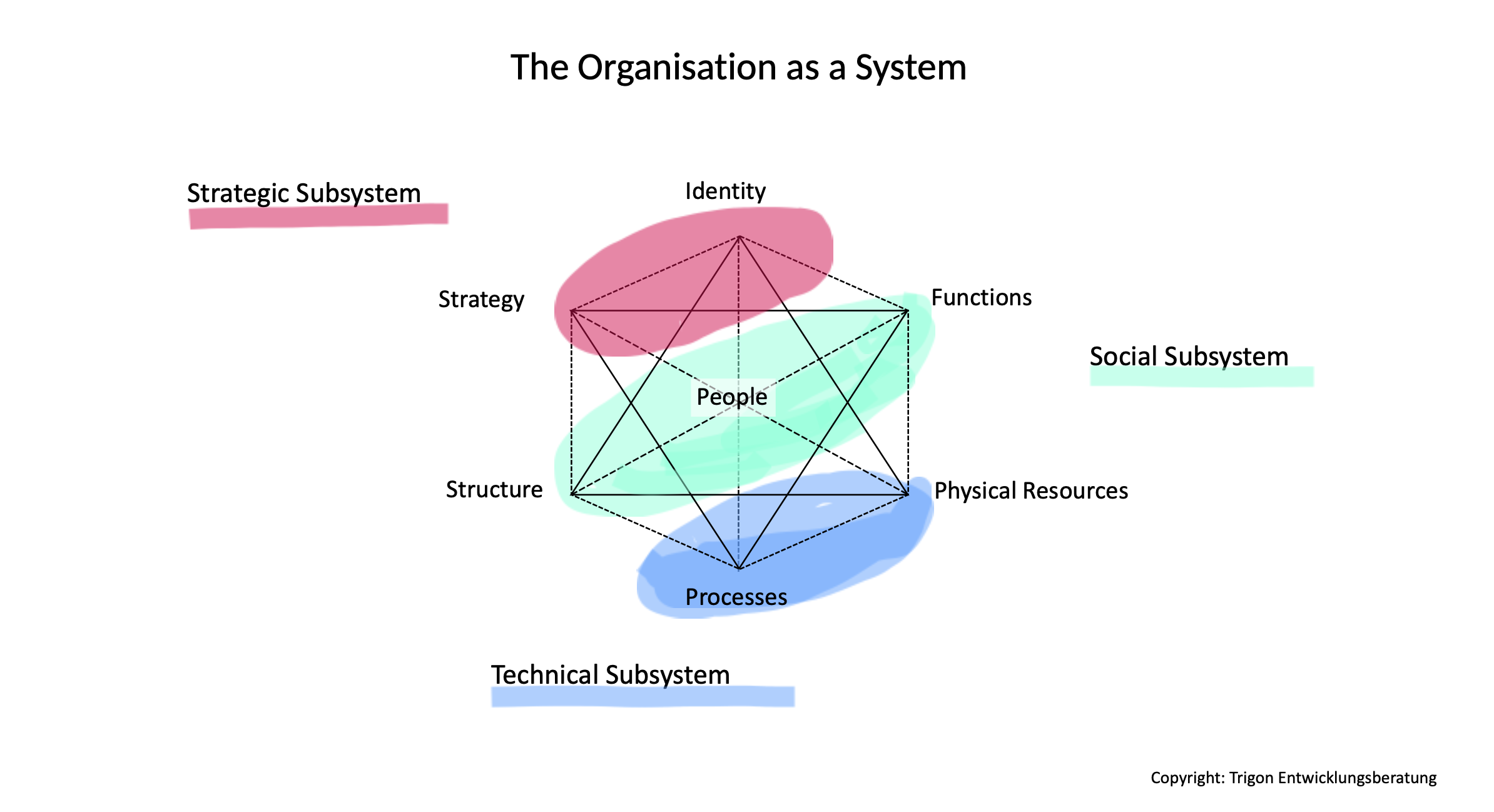
We work with the Trigon approach to organisational development. It examines an organisation as a whole — identity, strategy, structure, people, functions, processes and resources — and it requires a deliberate decision about where an intervention begins. At the start of every assignment we therefore establish together with the organisation the level we work on, whether that is the individual, the team or the structure.
Preliminary conversations with those responsible come first. Out of them we write a proposal that sets out an initial reading of the situation, the objectives of the work and an architecture of modules building on one another, each with its content, consulting days and fee.
The modules can be commissioned as a whole programme or individually. Starting with the first module alone is possible.
The diagnosis is part of the assignment rather than a step before it. It usually comprises interviews with the company's management, with the leaders concerned, with HR and with selected further participants.
We compare the expectations held at the different levels, examine the organisational and process structure, and identify the junctions at which work can be delayed. The result is a diagnostic report with recommendations.
On that basis we design the phase that follows together with the leadership team. What happens there in detail is not fixed before the diagnosis.
In the Trigon model, identity together with policy, strategy and programmes forms the cultural subsystem. Culture is therefore not a subject of work alongside the others but the result of working with all seven essential elements — identity, policy and strategy, structure, people and climate, individual functions, processes, and resources.
We therefore do not work on the culture but on the elements whose interplay produces it. Part of that is working with the images an organisation holds of itself: on the Trigon understanding they are seldom spoken aloud and nonetheless determine what counts as a problem and which solutions are considered. Making them explicit, discussing them and setting alternatives beside them belongs to this work.
Organisational development is coaching for organisations. We design the process together with the organisation, and the organisation runs most of it itself, with our support.
Our contribution is the design of that process, meaning who talks to whom and when, and how those conversations are prepared. Responsibility for the content and for putting it into practice stays with the people in the organisation.
A project is usually organised in phases: diagnosis, target picture and roles, capability building, and finally embedding and communication. The period follows the assignment and often runs to several months.
Longer stretches can lie between the phases, during which we are available for questions without being on site. We agree review points at the start, and we also state when, in our view, our involvement should end.
We ask for two things before an organisational project begins. The first is the active involvement of the company's management: they develop their own way of steering alongside the work, rather than leaving the change to the level below them.
The second is a clear separation between advice and decision. Whether a site is closed, who is promoted and which strategy is pursued is decided by the company's management. How such a decision is reached and who takes part in it is what we design.
We accompany change initiatives, culture work, team development and the redesign of how people work together — from diagnosis through workshop architecture to supporting the leadership group.
Following Matthias Varga von Kibéd, systemic is not an either/or but a matter of degree: one approach is more systemic than another where it does more to refrain from attributing properties to individual elements and looks instead at relations, structures, contexts and how those change. That is the standard we work to.
By listening. Usually with conversations across the organisation before anything is planned. What comes out of them often changes the assignment.
Both — the staffing follows the assignment. On large projects there is clear leadership, one point of contact for the client, and the right number of contributing experts alongside. Small assignments and global programmes are equally workable for us.
Please contact us to learn more about how our consulting services can develop your organisation.